




Thyroid Cancer
Uncommon, usually slow-growing, and in most cases curable.
What is it
Thyroid cancer develops when cells within the thyroid gland begin to grow abnormally and form a lump. It is diagnosed more often than it once was, largely because scans of the neck performed for unrelated reasons now pick up small nodules that would previously have gone unnoticed.
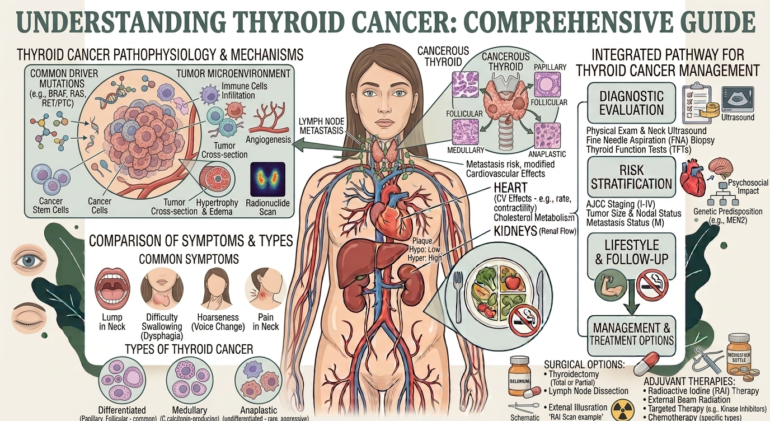
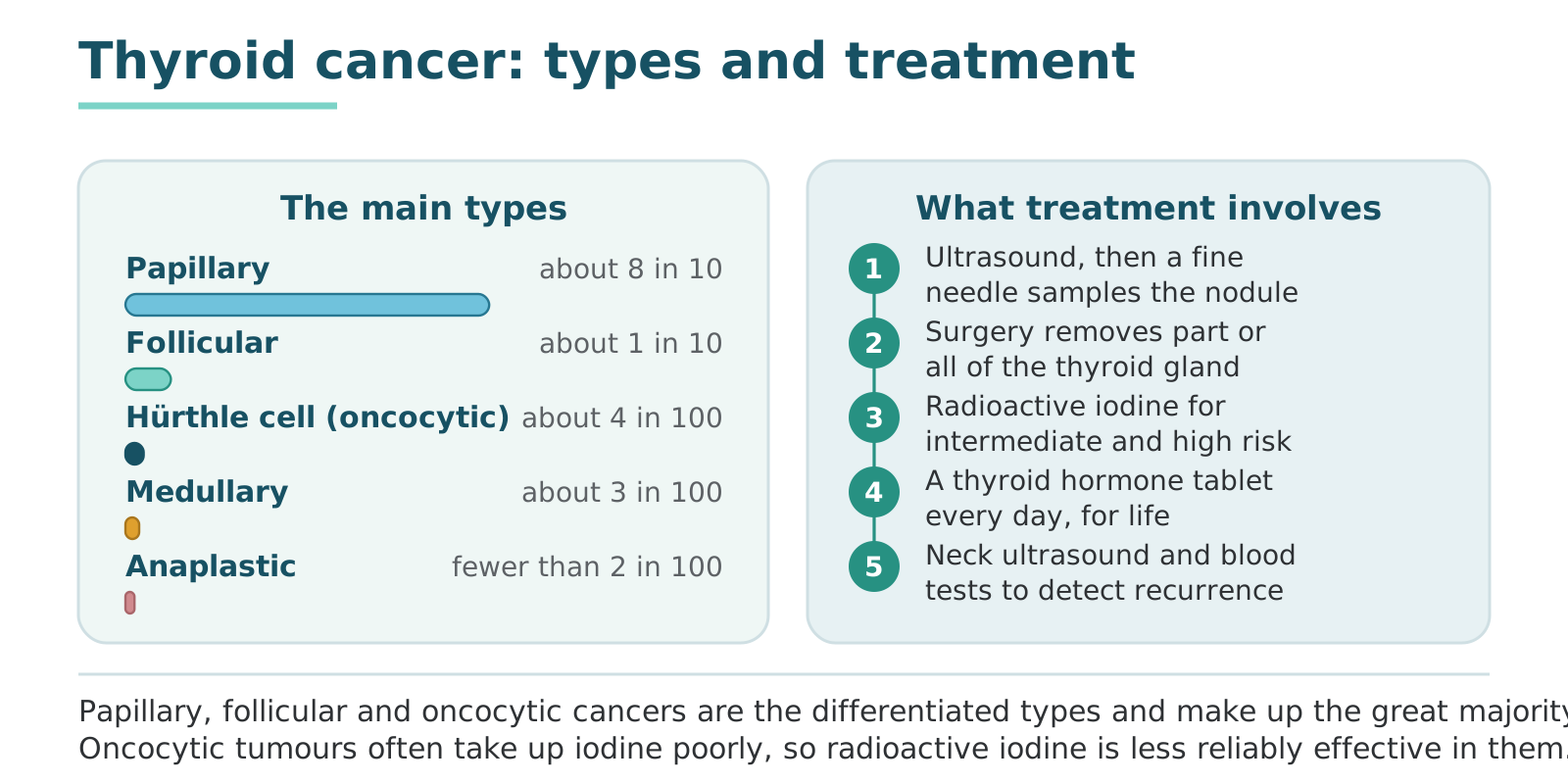
There are several distinct types, and they behave very differently from one another. Papillary thyroid cancer is by far the most common and typically grows slowly. Follicular thyroid cancer is the next most common. Hürthle cell cancer, now more correctly called oncocytic carcinoma, was for many years grouped together with follicular cancer but is today recognised as a type in its own right. These three are described collectively as differentiated thyroid cancers, because their cells still behave in many respects like normal thyroid tissue — which is precisely what makes them so treatable. Medullary thyroid cancer is uncommon, arises from a different cell type and can run in families. Anaplastic thyroid cancer is rare and behaves far more aggressively.
The great majority of people diagnosed have the papillary type, and the great majority are cured. For most patients this is a diagnosis to take seriously and treat properly, rather than one to fear.
How it is diagnosed
The pathway usually begins with a neck ultrasound, which measures the nodule and assesses its appearance for the features that warrant closer attention. Where those features are present, a fine- needle aspiration follows — a quick clinic procedure using a thin needle to sample cells for
examination under the microscope.
The pathologist grades the result on a standard scale that runs from clearly benign, through several degrees of uncertainty, to clearly malignant. A proportion of samples fall into the indeterminate middle, and in that situation molecular testing of the sample can help clarify whether surgery is
genuinely necessary or can reasonably be avoided.
Once a cancer is confirmed, further assessment establishes its extent. This means a carefulultrasound of the lymph nodes in the neck, sometimes a CT scan, and blood tests including thyroid function. Where a medullary cancer is suspected, a calcitonin level is measured and genetic testing is discussed, since this type can be inherited.
How it is managed
Surgery is the primary treatment for nearly all thyroid cancers. Depending on the size, type and behaviour of the tumour, this means removing either the affected half of the gland or the whole of it, sometimes together with lymph nodes from the neck. For very small, low-risk papillary cancers, careful monitoring rather than immediate surgery is now an accepted option in selected patients, and we will tell you honestly if you are one of them.
Radioactive iodine is used after surgery in some cases but not in all. Differentiated thyroid cancer cells take up iodine, which allows a dose of the radioactive form to find and destroy any cells that remain. It is reserved for intermediate- and high-risk disease — broadly, cancers that were larger, had spread to lymph nodes, or showed features suggesting a greater chance of returning. Low-risk cancers are generally not treated with it, and practice has moved steadily towards this more selective approach.
After the thyroid is removed, thyroid hormone replacement is required for life. In some patients the dose is set slightly higher than simple replacement, to keep TSH low and reduce the stimulus to any remaining thyroid cells. Surveillance then continues over the long term and rests on two things: periodic ultrasound of the neck, and blood tests — thyroglobulin together with thyroglobulin antibodies — which act as sensitive markers of recurrence. Used together, these are what allow any return of the disease to be detected early, while it is still straightforward to treat.
Complex cases are discussed at a multidisciplinary meeting where endocrinologists, surgeons, pathologists and nuclear medicine specialists review the findings together, so that the plan reflects more than one opinion.
Hürthle cell (oncocytic) thyroid cancer
Oncocytic carcinoma — still widely known as Hürthle cell cancer — is made up of a distinctive cell type crowded with the tiny structures that generate a cell’s energy, which gives it a characteristic appearance under the microscope. It was regarded for decades as a variant of follicular cancer and was reclassified as a separate entity in the 2022 World Health Organization framework. It accounts for a small minority of thyroid cancers.
It poses a particular diagnostic difficulty. A needle biopsy can establish that the cells are oncocytic, but it cannot reliably separate a benign oncocytic adenoma from a cancer, because that distinction rests on whether the tumour has invaded its own capsule or the blood vessels around it — something visible only once the nodule has been removed and examined whole. An operation to remove the affected lobe is therefore often needed to reach a firm answer, and molecular testing of the biopsy is less informative here than it is for other thyroid nodules.
Treatment is surgical and follows the same risk-based principles. One difference matters a good deal: oncocytic tumours frequently take up iodine poorly, so radioactive iodine is less reliably effective than it is in papillary and follicular cancer. Where a tumour does not take up iodine, a PET scan is usually the more useful way to look for any disease that remains.
This type is somewhat more likely than classic follicular cancer to spread to lymph nodes or beyond the neck, so follow-up tends to be closer. Surveillance follows the same pattern as the other differentiated cancers, with periodic neck ultrasound and blood tests. Most cases still confined to the thyroid at the time of surgery do well.
When to seek care promptly
A rapidly enlarging lump in the neck, new hoarseness, or difficulty swallowing or breathing should be assessed promptly. After thyroid surgery, tingling around the mouth or in the fingers, or muscle cramps, may indicate a low calcium level and should be reported straight away.
Further reading
The American Thyroid Association (thyroid.org) publishes detailed patient guides to each type of thyroid cancer, and the Endocrine Society patient hub (hormone.org) covers the condition as well.
Speak with our team
Our specialist endocrinologists diagnose and manage this condition every day. Request a consultation with our team today.