When the body’s sex hormone levels fall too low — in men and in women.
What is it
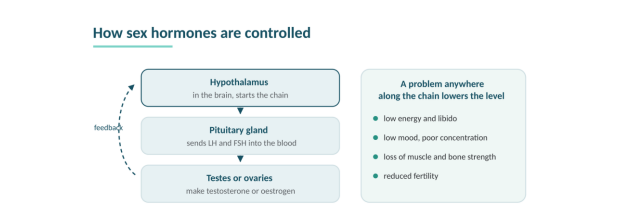
Sex hormones are controlled by a chain of signals. The hypothalamus in the brain signals the pituitary gland, which in turn instructs the testes or ovaries to produce testosterone or oestrogen. A problem anywhere along that chain can lower hormone levels, and part of our job is working out where in the chain the fault lies.
In men, low testosterone can cause low energy, reduced libido, erectile difficulties, low mood, poor concentration, and loss of muscle and bone strength.
The causes include problems with the testes themselves, pituitary conditions, obesity, certain medications and a number of chronic illnesses. Because hormone levels do fall gradually with age, careful testing is essential to distinguish true deficiency from normal ageing — and, just as importantly, to find an underlying cause that can be treated in its own right.
How it is diagnosed
Testosterone is highest in the morning, so blood samples are taken early in the day, and a low result is always confirmed on a second sample taken on a separate day before any diagnosis is made. A single low reading is not sufficient grounds for treatment.
The pituitary hormones LH and FSH are measured alongside it, and these indicate whether the problem lies in the testes themselves or higher up in the brain. Additional tests — prolactin, iron studies, thyroid function and a full blood count — help identify a specific cause. Imaging with a pituitary MRI, or a bone density scan to assess the effect on the skeleton, is arranged where indicated.
How it is managed
Wherever possible we treat the cause first. Weight loss, better sleep, a review of medications that suppress testosterone, or treatment of an underlying pituitary problem can restore levels without any need for hormone therapy at all.
Where deficiency is confirmed and you have symptoms, testosterone replacement is available as gels, patches or injections, and the choice between them is largely one of convenience and preference. One point deserves emphasis: standard testosterone therapy reduces sperm production. If you may want children, tell us before starting, because different treatments preserve fertility and switching later is not always straightforward.
Once on treatment, we check blood counts and, where appropriate, PSA at regular intervals, and review your symptoms to confirm the treatment is doing what it should. Because low hormone levels weaken bone, bone density is assessed and treated where necessary.
Further reading
The Endocrine Society patient hub (hormone.org) and the Urology Care Foundation (urologyhealth.org) provide further reading for patients.
Speak with our team
Our specialist endocrinologists diagnose and manage this condition every day. Request a consultation with our team today.